
VIVA, a culture of Sustainability: an interview with Alberto Tasca d’Almerita

The importance of wine in our economy should translate into an approach that considers the impact of production of one bottle on the environment. Developing this awareness, among both consumers and producers, is essential to generate a virtuous circle and safeguard out future.
Since 2010, Chiarlo has subscribed to VIVA, a project developed by the Italian Ministry for the Environment and Protection of Land and Sea to promote sustainable winegrowing. To have a better idea of what it entails, we interviewed Alberto Tasca d’Almerita, owner of the renowned Sicilian winery, Tasca d’Almerita, one of the first members and a spokesman for the project.
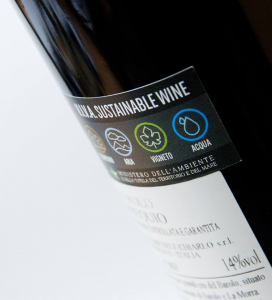
Our participation in the Ministry for the Environment’s project, VIVA Sustainable Wine is based on the premise that grapegrowing, the most widely farmed crop in the Piedmont hills, can mean a source of revenue, and at the same time, care of the landscape in all its aspects and along the entire production chain, from water consumption to carbon dioxide production, vineyard practices and working the land.
“Our Barolo Cerequio has been certified as a VIVA Sustainable Wine since the 2010 vintage. From 2013, all Michele Chiarlo Grand Crus have been VIVA certified”.
Goals?
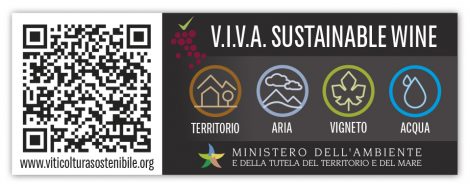
The VIVA Sustainable Wine project, aims to improve our winery’s sustainability performance by monitoring and developing good practices in all stages of the wine production chain. Not only, monitoring must be transparent and data easily available to the consumer, so every VIVA Sustainable Wine bears the project logo and a QR Code with which to verify the results achieved.
Indicators
VIVA Sustainable Wine takes four different indicators into account to assess the environmental impact of our winery.
AIR – evaluates the CO2 emissions across the life cycle of each product and the winery’s total climate-changing emissions for the purpose of reducing the carbon footprint of the entire production chain.
WATER – this indicator reveals the total volume of fresh water consumed by the winery for the purpose of combatting waste and pollution.
VINEYARD – the indicator takes into account agronomic management practices in the vineyards and their effect on the ecosystem.
REGION – this indicator was created to consider, when assessing sustainability, the landscape as the interaction between nature and man, evaluating companies’ activities and how they impact on the region.
TASCA D’ALMERTITA
The Tasca d’Almerita family have been winegrowers for eight generations. Two hundred years of experimentation and working the land have made Regaleali, located in the Madonie foothills between Palermo and Caltanissetta, one of Sicily’s leading wineries. The Tasca d’Almerita family embraced the VIVA project right from the start, becoming one of its spokesmen at home and abroad.
Alberto Tasca d’Almerita, why did you decide to join VIVA?

Alberto Tasca d’Almerita
VIVA originated with our personal vision of environmental responsibility. As a company we have always considered nature as a legacy to protect and preserve with sustainable practices. For some years now, these principles have created a new trend in informed consumption, attentive to environmental aspects and the impact generated by a certain style of production. VIVA results from the encounter between corporate and market values, from the search for the right balance between revenue and responsibility. It was a project we proposed to the then-Minister for the Environment, Corrado Clini, who was more than pleased to collaborate in the creation of a national certification based on scientific parameters
What motivated you to being among the first wineries involved in this project?
At that time, we needed to create a programme based on scientific protocols, and above all, on research. We needed fixed parameters that certified the sustainability of a company’s production chain as objectively as possible, and acted as a spur to improving. Scientifically analysing your environmental impact gives direction and sense to your work. It is important for family, artisanal wine producers to know that their land will still be productive and viable in generations to come. VIVA is the result of lengthy research, and is based on four cornerstones: water, air, vineyard and region, to each of which international standards and regulations, certified by a third-party body, apply.
What are the distinctive features of VIVA and why should a winery choose to become a member?
First of all, VIVA is a programme developed by the Ministry for the Environment, valid throughout Italy. Unlike other certifications, it offers dual-level monitoring: vertical, that is, the product, and horizontal, the organization of the entire winery. There are certifications that analyse only the product and encourage wineries to create “green” labels” without modifying their global impact. In this, I believe VIVA is the most advanced, complete system of sustainable winegrowing certification in Italy, because it provides for an all-encompassing ethical approach.
VIVA is not just a sustainability project, but one of transparency towards citizens and consumers.
Exactly. VIVA discloses results directly to consumers, and in a certain way, makes the winery dynamic and forward-looking, because the results of its commitment to the environment are there for all to see. Refusal to change is dangerous for those who work the land, because it promotes repetition and persistence with practices that are harmful, even if they are considered traditional.
How many wineries subscribe to VIVA, and why have they done so?
About fifty wineries. It may not seem many, but we are at the beginning of a process that is not simple, one that involves the entire production chain. Those who join VIVA do so first of all from a sense of ethics. Later, they realise that there is also a practical side – having the data available and making it public helps them monitor all aspects of their production and avoid waste. Certainly, a company must be ready to do this.
Are consumers in Italy ready to recognise the efforts made for VIVA?
We are still in the embryonic stage in Italy. This type of certification is part of the consumers’ culture abroad, especially in Northern Europe and North America. One of the aims of VIVA is to disseminate this culture and this awareness also in Italy
In your view, should transparency be a value that is more subscribed to in the wine industry?
Transparency is an added value for the consumer, but above all for the company itself. Operating in an honest way with others helps one to be honest with one’s self and recognise one’s limits. Transparency helps a company to grow, in all fields.
Do producers who are members of VIVA collaborate with each other?
VIVA is a project that puts results online. This creates healthy competition with regard to sustainability and encourages companies to do more and do better. And doing better in this field means doing better to the whole ecosystem. I would add that one of VIVA’s aims is to create groups of winegrowers who join together to meet the expense of certification and share the costs.
How do you envisage the development of this project?
I believe that VIVA is an essential and inevitable project. Because it is not an alternative to organic or biodynamic certification, or regional protocols, but an across-the-board programme that quantifies a company’s entire production chain and puts clear, transparent limits in place. I believe that the first evolution of VIVA is to communicate these limits, and from there a new course will be set for the whole industry.