
Cannubi Path: A Vineyard Told Through Art

Art is vision, craft, and the human imprint left over time. In its broadest sense, the Latin root ars refers to the ability to create with purpose and harmony. True art doesn’t impose itself – it engages in dialogue with its surroundings, intertwining with the landscape without altering its essence, adding a new layer of meaning.
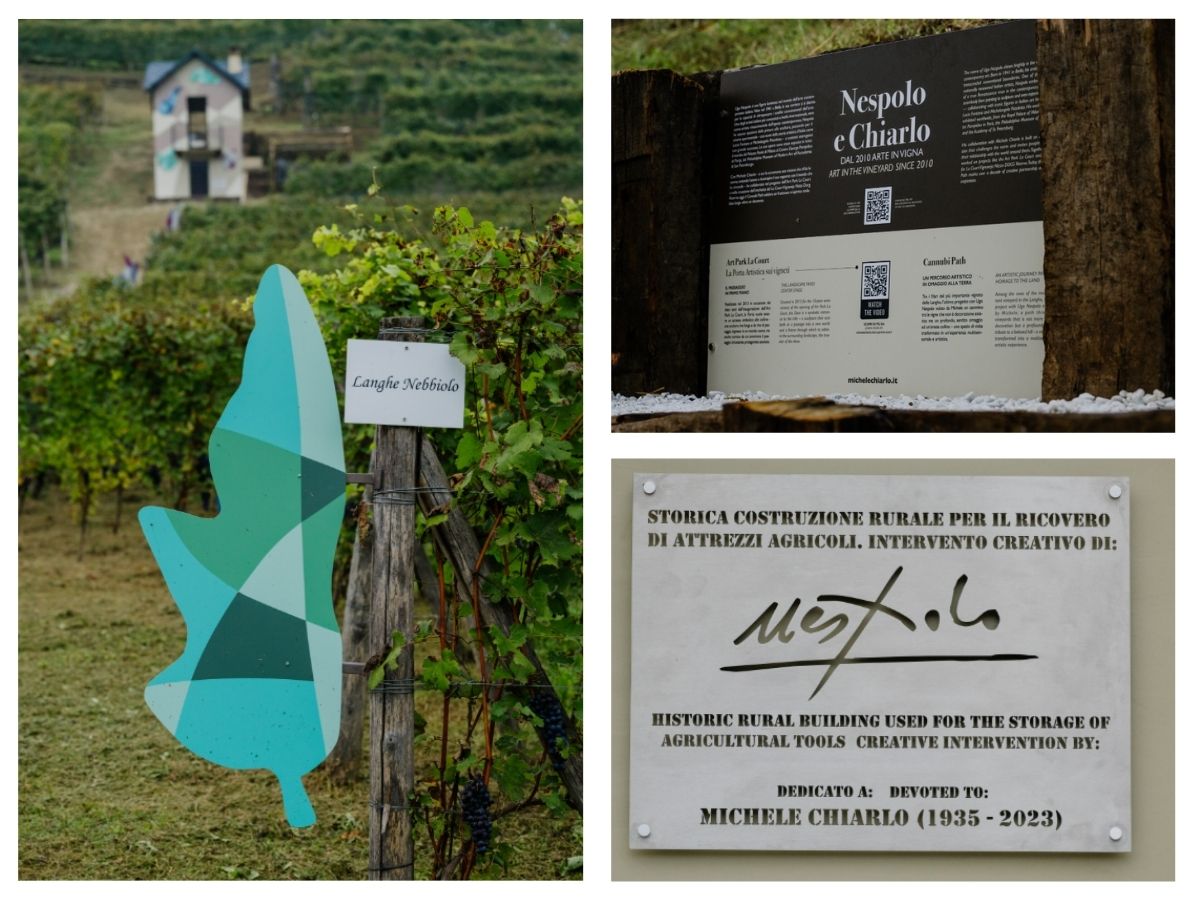
That is the essence of Cannubi Path, the latest addition – unveiled last October – to Michele Chiarlo’s experiential mosaic. More than an installation, it is an act of giving back, a tribute to the land, designed by Ugo Nespolo and dedicated to Michele Chiarlo. It transforms this beloved and iconic hillside into a space for visual and cultural reflection.
This is not decoration but an artistic journey, designed to restore the vineyard to the prominence it deserves. Through carefully placed installations, Cannubi Path invites visitors to pause, observe, and reflect on the creative relationship between humans and the land.
“Great vineyards have always meant everything to us. But at some point, we began to see them with new eyes.”
— Alberto Chiarlo
“It was the summer of 1996, during a sunset gathering in Cerequio. Palás was still a crumbling hamlet, but that evening, we realized that wine alone could not define the true value of these places. We felt the need to open them up, to invite people to walk through them, to absorb their beauty.”
This vision gave rise to the idea of integrating art into the vineyard – not as an addition, but as part of a broader narrative. First explored through the Art Park La Court, this concept now finds a new expression in Barolo’s most legendary cru, where wine meets the artistic language of Maestro Ugo Nespolo.
Cannubi: Italy’s Oldest Cru
Sought after by many, cultivated by only a few, Cannubi is Barolo’s most celebrated Menzione Geografica Aggiuntiva—and the oldest officially recognized cru in Italy. The first known bottle to bear its name on the label, now preserved in the Manzone family archive in Bra, dates back to 1752.
Cannubi’s most famous literary mention comes from Lorenzo Fantini, whose renowned Monograph on Viticulture and Enology in the Province of Cuneo (1879) identified it as one of the finest vineyard sites in the region. His research helped cement Cannubi’s reputation, first in Italy and later worldwide, as a source of truly exceptional Barolo.
Located at the heart of the Barolo appellation, Cannubi sits at the intersection of two geological formations: the compact, structured soils of the Helvetian era and the softer, more pliable Tortonian marls. Everything here aligns perfectly—altitude, exposure, soil composition, and microclimate—creating Barolo of extraordinary balance and depth.
Chiarlo’s Terraced Vineyard
Since 1989, Michele Chiarlo has cultivated one hectare in Cannubi’s historic core, home to the ciabot—the traditional vineyard hut of Cannubi. This steeply sloped vineyard was terraced under the guidance of Changins University, pioneering the first grass-covered terraces in a Langa cru. These terraces enhance sun exposure and prevent soil erosion, preserving the vineyard’s delicate equilibrium.
Planted entirely with Nebbiolo, the vineyard faces south and southwest at an elevation of approximately 240 meters. Its soils—a mix of Tortonian and Helvetian calcareous marls—are poor in organic matter but rich in microelements such as iron and magnesium, giving the grapes exceptional character and complexity.
This site lies within one of the six core zones of the Vineyard Landscapes of Langhe-Roero and Monferrato, recognized as a UNESCO World Heritage Site since 2014.